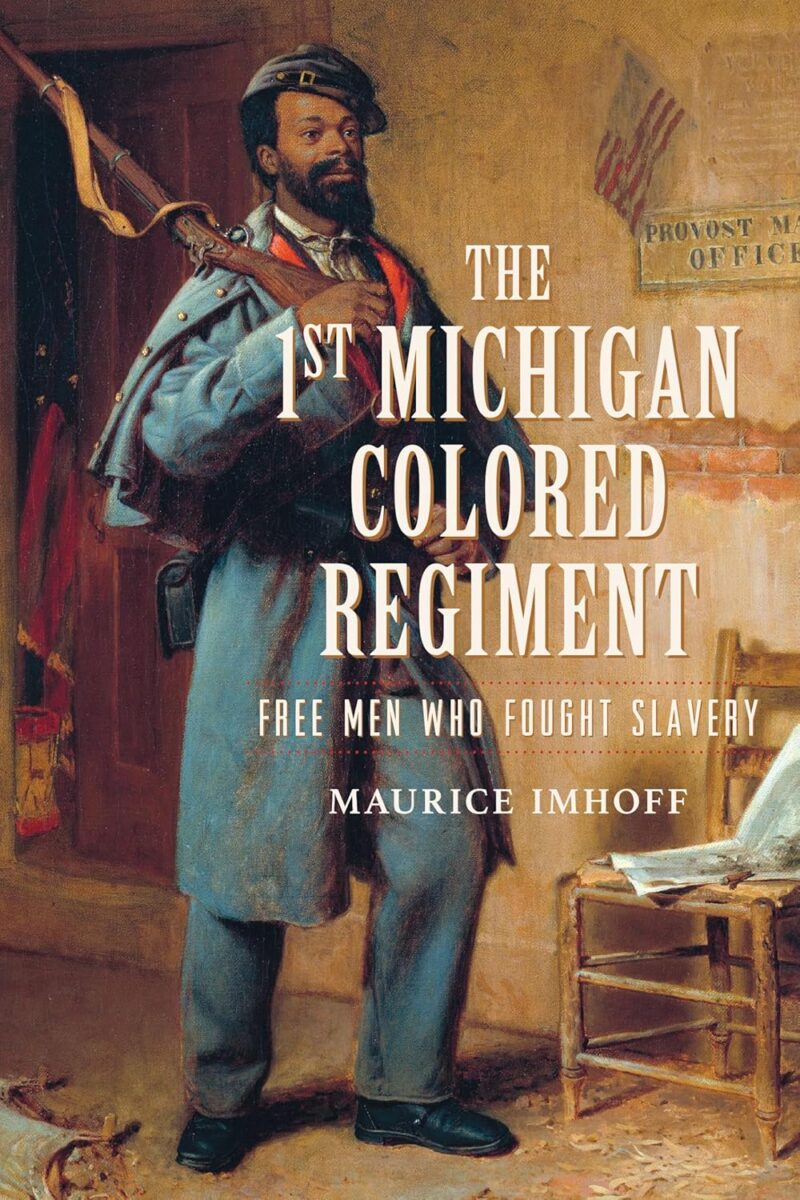
While most white northern soldiers fought for the salvation of the nation, African American soldiers were explicit in their goal of fighting for the emancipation of the millions of African Americans still in bondage. The story of the 1st Michigan Colored Regiment is just one of many African American regiments to take up arms, but their story has not been adequately told. Maurice Imhoff’s The 1st Michigan Colored Regiment: Free Men Who Fought Slavery follows the creation and wartime service of Michigan’s only Black regiment during the Civil War. The author anchors his narrative not just in the experiences of the individual soldiers, but also in their public reception.
Imhoff begins with a brief history of the world African Americans made in Michigan prior to the Civil War, as well as how the Emancipation Proclamation sent many into the army to free those still enslaved. At first, many Black Michiganders went to other northern states to enlist. In response, newspapers such as the Detroit Advertiser and Tribune called for the raising of a local regiment, both to keep Black Michiganders from enlisting elsewhere and to help fulfill the state’s enlistment quotas. After receiving official permission from Secretary of War Edwin M. Stanton to form the regiment, recruiting quickly began. Many individuals who enlisted had already been serving in the Union war effort as cooks, servants, or other noncombatant roles. Not wanting to be forever relegated to menial labor, these men took the opportunity to serve in a more official capacity; some even became noncommissioned officers. Once the regiment gained enough troops, it set out on a sort of publicity tour through the state, promoting the cause and gaining further recruits wherever they went. Once the tour was complete, the soldiers settled in Camp Ward in Detroit and awaited orders.
It did not take long for the regiment to see action. Upon mustering in on March 19, 1864, they debarked for South Carolina. Here, the 1st Michigan Colored Regiment was redesignated as the 102nd USCT, due to the War Department hoping to streamline army organization. The 102nd saw most of their combat experience in South Carolina, with some limited engagements in Georgia and Florida. They remained in the field for the rest of the war, mustering out in September 1865. Imhoff does not end his narrative with the disbanding of the regiment but instead chooses to follow these men’s postwar lives. He also explores the long-term legacy of the 102nd.
The First Michigan Colored Regiment joins a growing shelf of regimental histories, providing an accessible account of Michigan’s only African American regiment. Imhoff’s book is more than just an account of where this unit went and what its soldiers did. He takes great care to locate these men in the wider context of the Civil War. Black soldiers had different motivations for serving and a different perspective on the conflict, a point that Imhoff expertly conveys. Scholars of the Civil War at any level will find Imhoff’s work an illuminating look at Black soldiers’ experiences and commitment to the cause.
Greyson Bettendorf is a graduate student in the Department of History at the University of South Carolina.