Historian Jonathan Noyalas discusses the significance and impact of several key advances in Civil War era ammunition.
Transcript
John Heckman: Jonathan, it’s great to have you on the podcast series. I am so happy to be talking about something that we rarely talk about, which is Civil War ammunition. So, thank you for joining us.
Jonathan Noyales: Yeah, I’m delighted to be here. Thanks for the invite.
John Heckman: We both have talked with a lot of people over the years about muskets and rifled muskets and about Civil War combat. But we tend to get in these questions about, what is a musket or what is a rifled musket? Can you go over that, first of all, Jonathan, because I think that’s something that we field a lot.
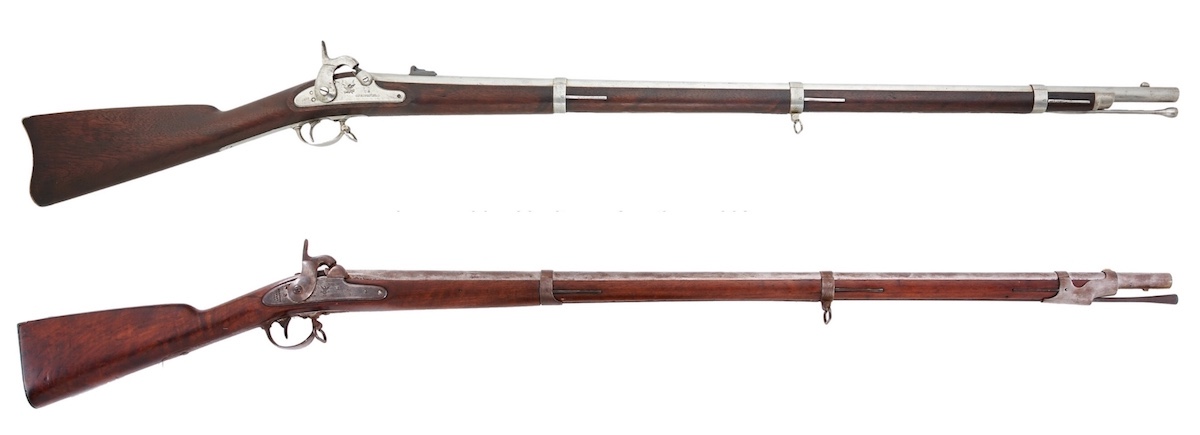
Jonathan Noyales: Yeah. And I think there’s a common misconception. I think people use those terms interchangeably, right? So predominantly in the Civil War, the way I explain it to my students, there’s two types of muzzle-loading firearms. You have a smoothbore musket. So if you think about, like, the Model 1842, .69 caliber smoothbore, it’s basically a pipe. You load a round ball down it and you shoot it. And on the other side you have the rifled musket. So things like the Model 1861 Springfield, the Model 1853 Enfield rifled musket. These things are much more accurate. They have rifling. So it’s a series of grooves and lands cut into the barrel and there’s a twist on them as they go down the barrel. And, of course, they are shooting a bullet that is made out of lead. It’s a minie-style bullet. It has a cavity in the base of the bullet. And as the explosion happens in the barrel, it flares out that bullet, it grabs the rifling, and it takes the twist of that bullet as it moves out. And that produces greater accuracy.
So, when you think about a smoothbore musket, they are deadly and they pack a punch. Probably maximum accuracy, 50 to 75 yards—it’ll reach out further than that—in terms of aiming at something and hitting what you’re aiming at. And then of course you have the rifle musket. In the hands of a well-trained marksman, you could accurately hit something, 300, 400, 500 yards away.
 Heritage Auctions (ha.com)
The rifled Model 1861 Springfield (top) and the Model 1842, .69 caliber smoothbore.
John Heckman: With the round-ball musket, is that the reason why we have just massive amounts of men smashed together because they’re hoping to hit a target at 75 yards away?
Jonathan Noyales: Yeah. So I think, part of it, goes back to Revolutionary War-style tactics, Napoleonic tactics. And part of it is massing those men. But also one of the things sometimes people forget about, when you’re moving troops on a battlefield, you also have to be able to effectively communicate with them. And so, having troops massed together, you think about how you can communicate on a Civil War battlefield. You have voice commands, you have drum, you have bugle. So you have to have these troops massed together to move. But, certainly, the smoothbore technology contributes to those types of formations that are used on the battlefield.
John Heckman: I hear a lot of times people asking about cartridges. They’ll hear that their ancestor received 40 cartridges before they went into battle, or 80 cartridges before they went into a battle. And sometimes people don’t understand the concept of a paper cartridge. Can you go over that a little bit, Jonathan? If you’re issued a cartridge, what does that cartridge look like or what are the components?
Jonathan Noyales: So basic cartridge—and again, whether you’re talking about a cartridge for a. 69 caliber smoothbore or a .58 caliber Springfield musket—it basically has several components. There’s a bullet. There’s the black powder. And so, traditionally, the service charge in a Springfield musket, it’s usually about 60 grains of black powder. And all of that stuff is wrapped together in a paper cartridge. And then when the soldier gets to loading that cartridge, you have to disassemble everything really quickly and load it. And then shoot it at your enemy. So, the cartridge in and of itself, it’s really a simple basic construction: paper, black powder, and the lead bullet. But there are variations on this that make things a little bit easier for soldiers later on in the war.
 The Horse Soldier (horsesoldier.com)
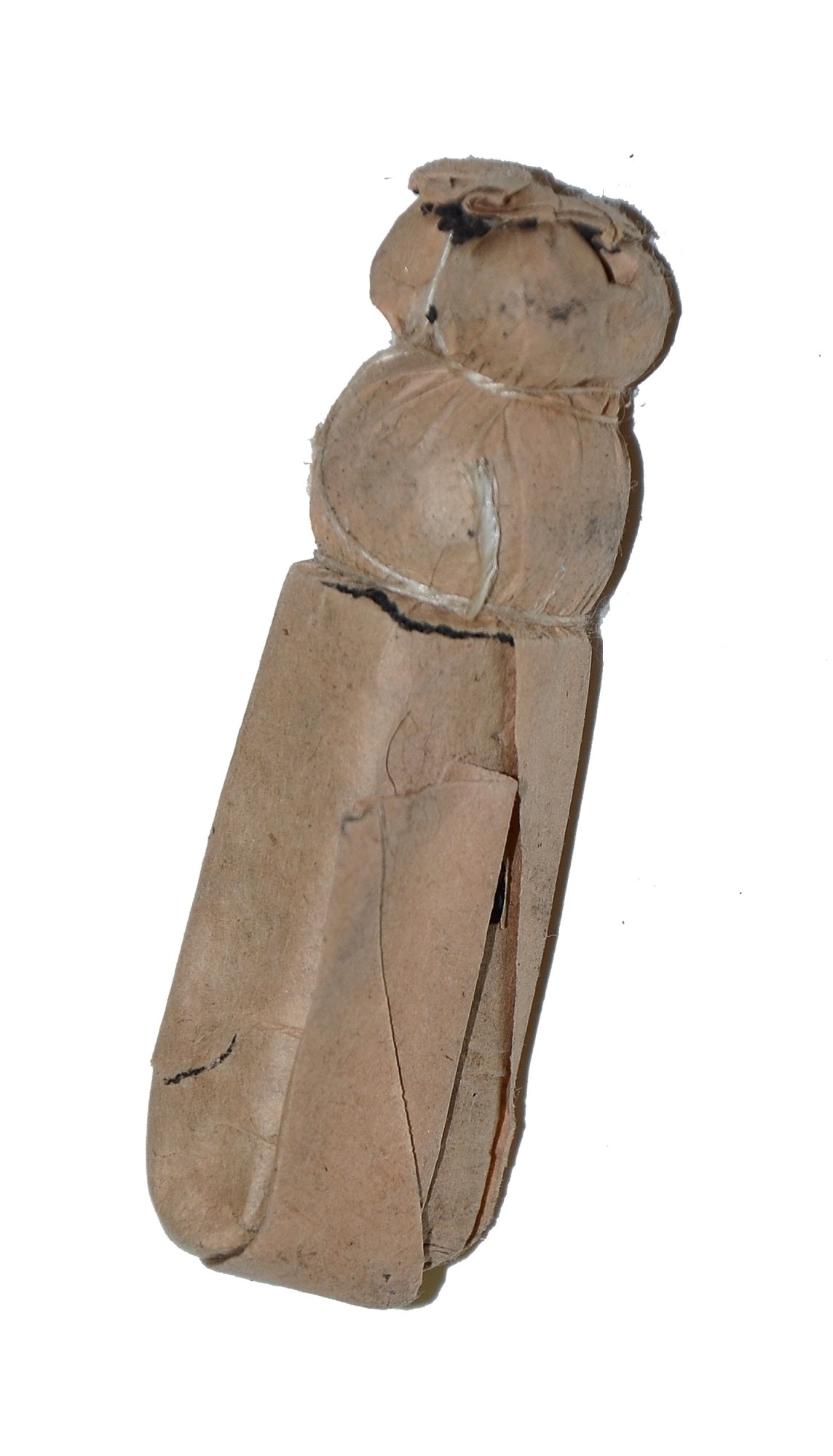
A buck and ball cartridge
John Heckman: Yeah, I’m really interested in the variations because I’ve shot round ball before and I’ve actually shot buck and ball. Quite a few people have heard of buck and ball, but they don’t realize the deadly potential maybe of buck and ball or the wounding potential of buck and ball. We hear sometimes of the Irish Brigade having buck and ball and other units. What are we talking about when we talk about a buck and ball round as compared to just the round ball?
Jonathan Noyales: So buck and ball, you’re right, it is extremely deadly. So, basically, in a buck and ball, you have the .69 caliber round ball, and then there are three smaller round balls attached to it. And so it’s contained in the same type of cartridge: powder, bullet. But these things are extremely deadly. And actually there are officers throughout the war—particularly in closer distances, closer ranges—that preferred smoothbore muskets and buck and ball. One of them, Colonel Richard Coulter, who is the commander of the 11th Pennsylvania Volunteer Infantry—for those of your listeners who are aficionados of the Battle of Gettysburg, the 11th has probably one of the most iconic monuments on the first day’s field standing out there on Oak Ridge, Sally Ann Jarret, the mascot, the Brindle Bull Terrier mascot sitting at the base of that monument. But Colonel Coulter actually preferred buck and ball, especially at those close distances. And not to get too much off our track here, but if you look really closely at the 11th monument at Gettysburg, the soldier is holding a model 1816 conversion. These are actually flintlock muskets at the outset of the war that were converted from flintlock to percussion. So they’re using the percussion cap ignition system. And they were .72 caliber. And so you could actually shoot the buck and ball out of them. That’s why when that monument was being created, the 11th Pennsylvania, that was their nod to Colonel Coulter like, hey, the smoothbore really is at times a superior firearm, and the buck and ball is a superior type of ammunition if you’re shooting in that 50 to 75, 90 yard distance.
John Heckman: So those are the guys that really chewed up Iverson’s brigade…
Jonathan Noyales: That’s correct.
John Heckman: … coming across the field on July 1. I never realized that they had buck and ball until this conversation. And that makes it even more interesting to me about how that advance was checked so readily by that group.
Jonathan Noyales: Yeah, I think there were two companies of the 11th that actually had smoothbores at Gettysburg. I could be wrong, but if memory serves, I think that’s the case.
 Union Drummer Boy (uniondb.com)
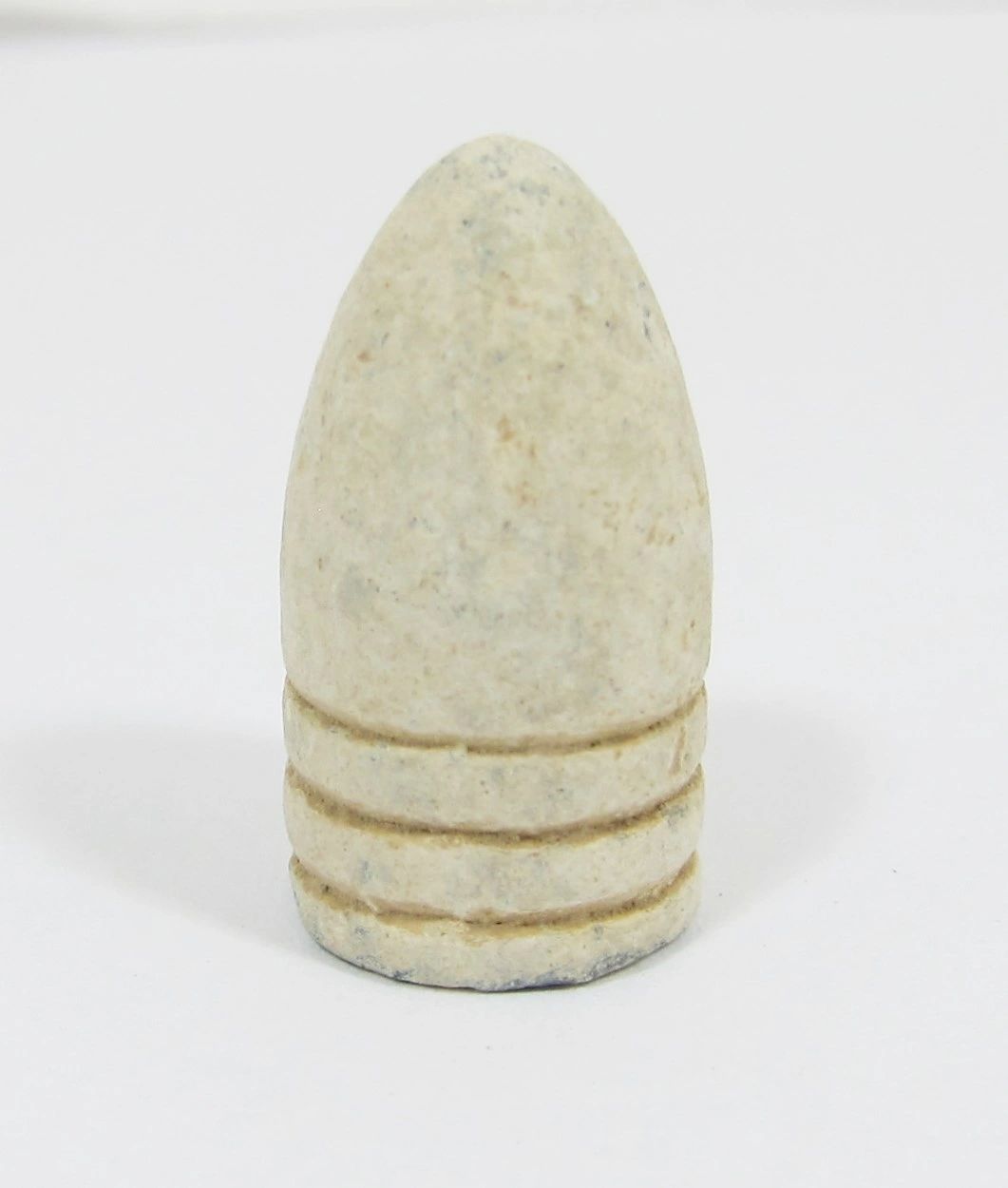
A Civil War minie ball
John Heckman: So many people have the understanding that we’re starting to see this transition in ammunition during the Civil War. That’s been around maybe for a little while, but now the American continent is starting to see it for the first time. And one of those would be the minie ball. How does that really impact the idea of ammunition in the Civil War? Because I’ve often told people, round ball to me was like throwing a knuckle ball, but the minie ball was like throwing a football. How has that really transferred into U.S. military thought at this time, and even Confederate military thought?
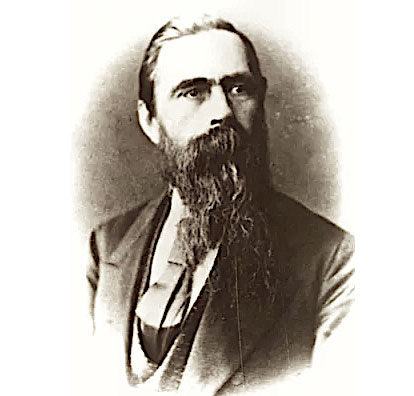
Jonathan Noyales: Yeah, that’s a great analogy. One of the things that the minie ball does is it allows you to engage your enemy at a greater distance. So if you think about the smoothbore, whether you’re just shooting a round ball or buck and ball, you are going to have to engage your enemy at a much closer range. If you’re shooting a minie bullet, obviously you can be 300, 500 yards out and you can start shooting at your enemy. But when you think about that innovation, the Americans don’t come up with the concept. Claude Manet is the one who develops the concept. But the bullet that’s used during the Civil War, the popular bullet that’s conical shaped, three grooves, the hollow base, that’s really the design of James Henry Burton, who was the master armorer at Harpers Ferry in the mid-1850s and was really tasked with trying to figure out, like, how do we take what Europeans have done with the conical shaped bullet and make that more effective?
And it’s really interesting. If you look at the technology going back to the 1830s and 1840s, the Europeans were trying to figure out how can we make a bullet in a rifled musket expand and grab the rifling? Some of the initial ideas were to take an iron spike, a metal spike in the breach of the musket barrel and pour the powder down the barrel and then you would ram the bullet. Of course, it’s made out of lead, but the bullet was solid. The idea was the more you ram it down, it would flatten out and flare out and grab the rifling. The problem is you deform the nose of the bullet if it’s conical in shape, and that of course impacts the accuracy of it. And so then you get to Manet, who is developing this idea where there’s this little iron plug in the base of the bullet that when you fire, it expands and pushes out the lead.
 National Park Service
James Henry Burton
But Burton is the one who basically says if we have a conical bullet with a thin lead skirt, that explosion is just going to flare it out and grab the rifling. So I don’t think Burton really gets enough credit for the role that he plays in designing a bullet for a war that he doesn’t even know is going to be fought. And, obviously, the accuracy is greatly improved as a result of that. And, of course, the destructive force is there. I mean, if you look at photographs in The Medical and Surgical History of the Civil War, you can see images of what a minie bullet does to bone. And it just shatters that bone. There’s nothing you can do other than amputation. And so it is really a destructive missile.
John Heckman: What’s it like to shoot one of these muskets? A lot of people go and they see a firing demonstration or they go to a reenactment. To me, it’s a lot different when you’re actually firing it live as compared to if you’re seeing someone fire a blank round.
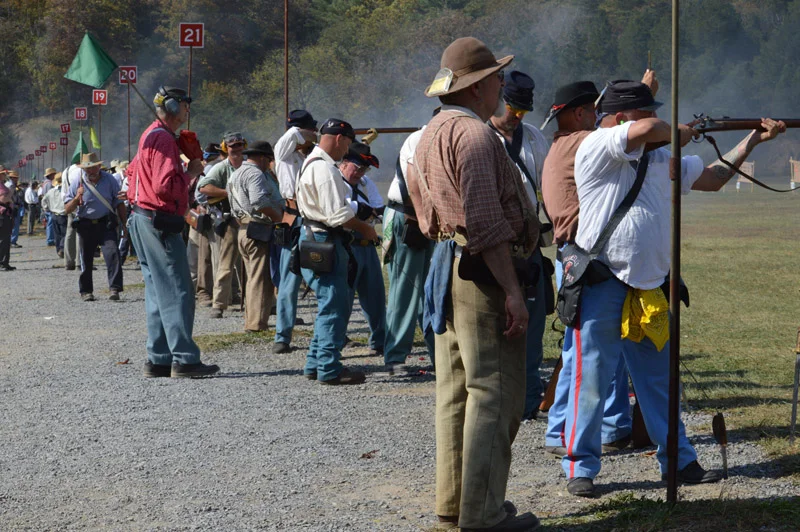
Jonathan Noyales: Yeah. So, I’ve been shooting in the North-South Skirmish Association now for over 30 years, and there is a great difference between doing a blank demonstration at a reenactment or a living history event and shooting live. And so the N-SSA, for those listeners who aren’t aware, they have ranges all over the country, but the home range is just outside of Winchester. It’s called Fort Shenandoah, near Gainesboro, Virginia. And N-SSA shoots competitions at traditionally 50 and 100 yards for carbine and rifled musket and Sharps rifles and those types of things. And then they have smoothbore competitions at 25 and 50 yards.
One of the things that shooting live ammunition does as a historian is it really helps you understand the deadliness of combat and the accuracy of these weapons. Because, again, you’ve done living history earlier in your life. I’ve done it. And I remember speaking to people at different places, whether a state battlefield park, a national battlefield park, whatever the case is. And there is this misconception that Civil War firearms were inaccurate. And that’s not at all the case.
So you think about shooting a live round at 100 yards. So, for example, North-South Skirmish Association, traditionally the 100-yard target is a six-inch tile. A team of eight people could clear those targets in like 87 seconds. The team that I shoot on, like we’ve done that over the years at 100 yards. So put a six-inch tile over your face, okay, and think about looking at that at 100 yards. Very quickly those things are going down. So those muskets, that type of ammunition, it is deadly, deadly, accurate. And the same for smoothbore. When you think about shooting a smoothbore live ammunition at 25 yards, shooting at a clay pigeon. So what is that, like, three and a half inches roughly in diameter? It just obliterates the pigeon. And actually, oftentimes it will suck the pigeon. So we put the pigeons on a cardboard backer, and it will actually suck the pigeon through the cardboard. So it leaves this big, massive hole. And, so, when you shoot live, I think you have a greater appreciation for the accuracy of it all and for the destructive nature of it all. Because it just pulverizes those things, those targets.
 North-South Skirmish Association (n-ssa.org)
An event at the North-South Skirmish Association.
John Heckman: Do you think there’s a timeless issue going on here with men under fire not aiming like they would normally? Like, they’re anxious, they’re amped up, they’re seeing their people go down next to them. Do you think, especially when they’re green, they’re not really aiming as well as they should be, or could be, or they’re just firing away just to maybe even just scare their opponent, and that’s where this idea of “Oh, everything’s inaccurate” comes from?
Jonathan Noyales: Yeah, so that’s a great question. There are a lot of studies, and I know you’re aware of these, not only from the Civil War but from like World War II and Vietnam, that explore soldiers in combat. Because you would think about, why are the casualty rates as high as they are? Why aren’t they higher? And so, people are saying, well, maybe they’re not really aiming or they’re shooting above the target or whatever the case is. I’ve never been in combat. I don’t think you’ve ever been in combat, right, John?
John Heckman: No.
Jonathan Noyales: I don’t know what it would be like to stare down the barrel of a firearm, pointing it at another person. So, soldiers have those individual battles that they’re going through. Can I do it? But one of the other things that really ties into this idea that Civil War firearms are inaccurate is the type of cartridge. So we talked about the cartridge that’s used in the smoothbore musket and the rifle musket. You have the bullet, the powder, all wrapped in paper. One of the things that people oftentimes don’t think about is that when you’re in combat and you’re going through that nine-step loading procedure, you have people who are shooting at you. You’re in a very tense, anxious environment and you have to think about, I’m tearing the cartridge, am I getting all the powder down into the musket?
 National Archives
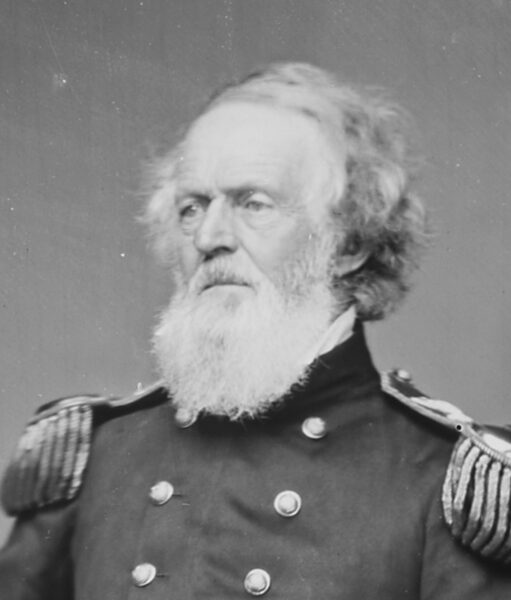
Joseph Mansfield
General Joseph Mansfield, who was the famed commander of the XII Corps mortally wounded at the Battle of Antietam, just six days before the Battle of Antietam he wrote a letter extolling the virtues of a new type of cartridge that was being used. It’s called the Johnston & Dow. And one of the things that General Mansfield discussed was the fact that so many soldiers, when they’re on the battlefield and they’re moving on the battlefield, they’re shaken. They’re not getting all the powder into the musket. And so instead of loading that 60 or 70 grain service charge, you might only be getting 20 or 30 grains. Well, that bullet’s not going to go far. It’s just going to die in midair and not hit anything. And so, when you think about the inaccuracy of Civil War firearms or the perceived inaccuracy, I think you have to take that into account. So there is the personal perspective of the soldier. Can I do this? There is, I just want to shoot as quickly as I can to create as much of a ruckus as I can. Hopefully that will deter the enemy. But then there’s like that practical, am I getting all the powder in the musket that I need in order to make the shot as accurate as possible? And so that’s a real concern for officers.
John Heckman: What is this Johnston & Dow cartridge that he’s speaking of?
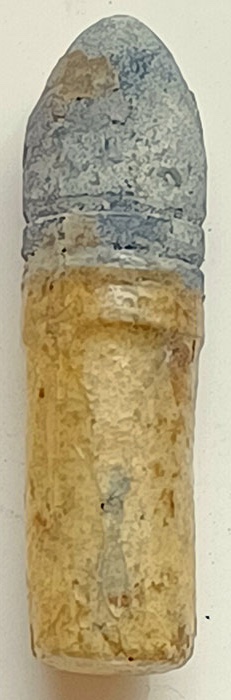
Jonathan Noyales: Yeah. So, this is something that’s a great innovation during the Civil War. This is a combustible, self-contained cartridge. So you have the basic components—you have the black powder, you have the bullet. Only the powder is wrapped in paper. And it’s fixed to the bullet, so the bullet is exposed. On a regular musket cartridge it would not be exposed. The paper itself was treated with collodion. The same stuff that photographers were using to develop photographs at that time was used to waterproof the cartridge.
 The Horse Soldier (horsesoldier.com)
A Johnston & Dow rifle musket cartridge
And so you would load, instead of tearing the bullet and pouring the powder, all those types of things, you would just load the entire cartridge. You would just ram the whole thing down. Think about all the steps that that takes out of the equation. You don’t have to worry about losing powder. And that was one of the things that General Mansfield, September 11, 1862, was writing to officials in Washington about, the superiority of this cartridge. Now my guys can load while they’re moving and not have to worry about spilling any powder. And you know that every round that’s coming out of the musket at the same time is going to have that same amount of accuracy. There are soldiers from like the 10th Maine at the Battle of Antietam who use that cartridge, extolling its virtues. There are also these moments during the war where Union soldiers are attributing their victory over a numerically superior foe to this type of cartridge.
There’s a very small engagement that happened on July 20, 1864, just north of Winchester. It’s called the Battle of Rutherford’s Farm. And it really is, as Civil war engagements go, a really, really small-sized battle. You basically had a division of Confederates commanded by General Steven Dotson Ramseur, so about 5,000 soldiers, going up against a Union force commanded by General William Averell, who was just descending from Martinsburg on Winchester. And so these two forces, they clashed north of the city of Winchester. This is a battle where Ramseur has the Federals outnumbered two to one. You would think that Ramseur would win. He loses. It’s a disastrous defeat for him. And there are soldiers in the 14th West Virginia, Corporal Jesse Tyler Stern, for instance, who wrote that he attributed their success to using this type of combustible cartridge. He said, we had never used this type of cartridge before. It was the first time they used it, and it allowed them to keep up a more rapid rate of fire.
There are accounts of the Johnston & Dow being used at other battles. For instance, there was a soldier at the Battle of Gaines Mill in 1862 who said, we were able to double our rate of fire. So if you think about this, the well-trained infantrymen could get off three aimed shots a minute. Well, you’re talking six shots a minute now. So that kind of equalizes things if you’re outnumbered. And what’s interesting is one of the other things that some soldiers wrote about is that the more they shot—obviously heat expands the barrel of the musket a little bit—and so there’s this soldier from the 4th New Jersey Infantry, Private John Beach. He actually wrote that, as the barrel heated up, you could just drop the cartridge down and like tap it on the ground and it was ready to go. Like you didn’t even have to use the ramrod any longer. And so you think about how that kind of, you know, especially if you’re in a situation where you don’t have the numbers, how that kind of equalizes things a little bit.
John Heckman: So is it just a matter of it was too expensive for the government to issue more of this? Or was there some kind of fallout with the contractor? Why weren’t more receiving this kind of ammunition?
Jonathan Noyales: I think part of it is the government had, I mean there are numerous examples, especially in the East, of the Johnston & Dow being used throughout the war, but especially from September 1862 onward. I think it really comes down to the government had so many of the traditional cartridges in stock that they wanted to use those things up first. And you look at the chief of ordnance, Charles Ripley, this is a guy I think who gets a little bit of a bad rap. Ripley is not seen as someone who’s a great fan of innovation. But I think he’s also trying to be as efficient as possible. Like the government orders millions of rounds of ammunition, why are we just going to chuck these things away? So I think it’s not so much the government saying, oh, there’s a fallout with a contractor, or whatever the case is. I think there’s this sort of financial pragmatism that we want to use what we have first, and then we can use the other things.
John Heckman: I’ve known a few people who have gone out to private land and have done metal detecting and have gone to these campsites and found ammunition. They found minie balls or they found round ball. And a lot of them have spoken with me about going down around the Fredericksburg area, and they would find piles dumped of Shaler bullets. And I always wondered why that is. Can you explain what the Shaler round is? And maybe why soldiers would not like it.
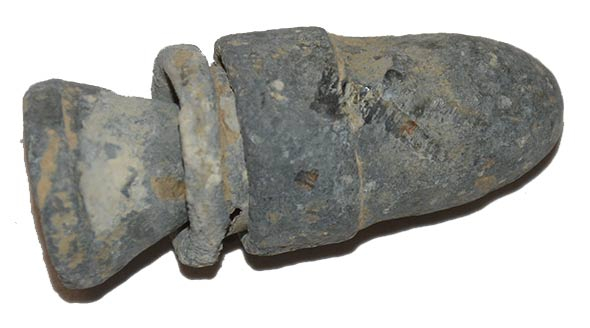
Jonathan Noyales: Yeah. So the Shaler is one of two types of what we might call explosive bullets that were used during the Civil War. So the Shaler is really simple in design. It basically is three lead cones that are stacked one on top of another. So it would be contained in the same type of paper cartridge. But it was really, I would think, I’ve never shot a Shaler bullet, but I would think it would be very difficult to load. Because you have to separate the bullet from the powder as you would a traditional minie bullet from the powder, pour the powder down, and you’d have to make certain that those three bullets, the three cones, don’t come apart. And there was a system where they were attached with paper and a string, but I think you’re going to have to fuss around a lot with that type of bullet. The idea behind it, though, was kind of like buck and ball for a rifled musket, in essence. So the idea is you shoot it, and what is loaded essentially as one bullet, it goes out and it becomes three.
 The Horse Soldier (horsesoldier.com)
A 3-piece Shaler bullet
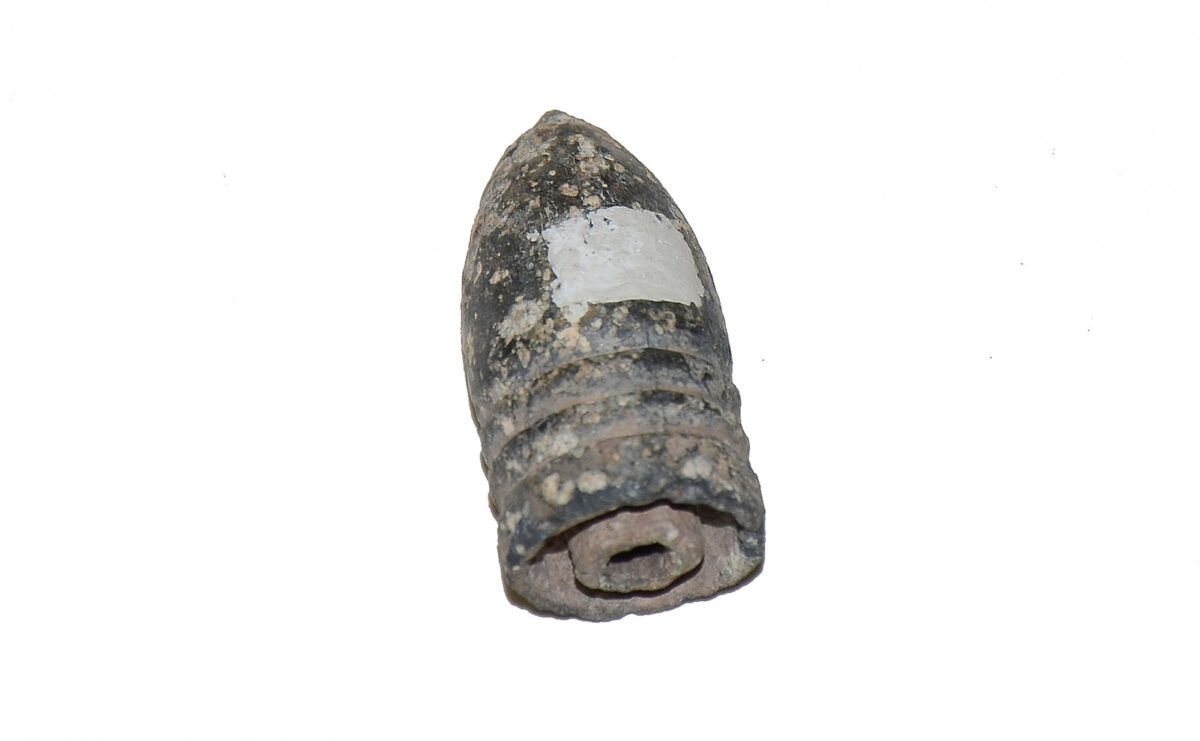
There was another type of explosive shell that was used that actually caused all kinds of furor, and that was the Gardiner explosive shell. So the Gardiner explosive shell was developed early in the war, and it actually comes from a British design. So when the British were dealing with the Sepoy Mutiny in India in the 1850s, there was a British major whose name was John Jacob trying to figure out a way to blow up limber chests of the opposition in India. And so he came up with this idea for an explosive bullet that ultimately Samuel Gardiner, the developer of this during the Civil War, went off and came up with his own design. But, basically, the Gardiner explosive shell, it was not made of lead, it was made out of pewter. And so pewter is a much more brittle metal, and it would load the same way as, you know, a traditional minie bullet. You have the powder, you have the bullet, but in the back of the bullet where the cavity was there was a little copper tube and it had a filament of like fulminated mercury or some other explosive in there. And so the idea was when you would shoot the musket, the bullet goes out and it ignites that fulminated mercury in the copper filament. And a second out of it, it bursts and it sends all these little tiny bits of pewter shrapnel everywhere.
So there was a great effort on the part of Benjamin French, the Commissioner of Public buildings in Washington, D.C. He was a close friend of Lincoln. But he also was a close friend of Samuel Gardiner, who had developed this bullet. And so there were tests done on the Gardiner bullet. Ultimately it was used at different points in the war, but not with any great degree of frequency because there were challenges that come with it. I think most notorious would be the 2nd New Hampshire Infantry. They were issued Gardiner explosive shells at the Battle of Gettysburg. And there are these horror stories of guys in the 2nd New Hampshire who actually have their cartridge boxes hit by an enemy round. So the 2nd New Hampshire is, you know, III Corps fighting in the area of the Peach Orchard. And when their cartridge boxes are hit, well, the box blows up. And then you have this secondary explosion where all these other shells are exploding. And there’s actually one really horrific story of a corporal from that regiment who had been wounded, the box was struck, and then he’s getting shot like multiple other times with rounds in his own box.
 The Horse Soldier (horsesoldier.com)
A Gardiner explosive shell
Ultimately, that Gardiner shell isn’t used a lot. There was a huge outcry in the press, in the northern press about this. They were basically saying, hey, look, this shell is just barbaric. Because they thought that the idea was this bullet hits you and actually explodes inside of the person, which is not how Gardiner initially designed it. But that does happen on occasion if the technology fails. And, ultimately, you get to this point after the war, I mean there were like international tribunals held that outlawed it. There was one in St. Petersburg, Russia, in 1868 where this tribunal was held to basically outlaw this type of explosive bullet in combat because it was seen as barbaric. Like a regular bullet was going to stop someone just as effectively as this, but the Gardiner, if it worked as it should have worked, made the wounds all that much more horrific.
John Heckman: Do you think this is another misconception we have about Civil War combat, in that we think that both sides are issued the same kind of ammunition?
 Union Drummer Boy (uniondb.com)
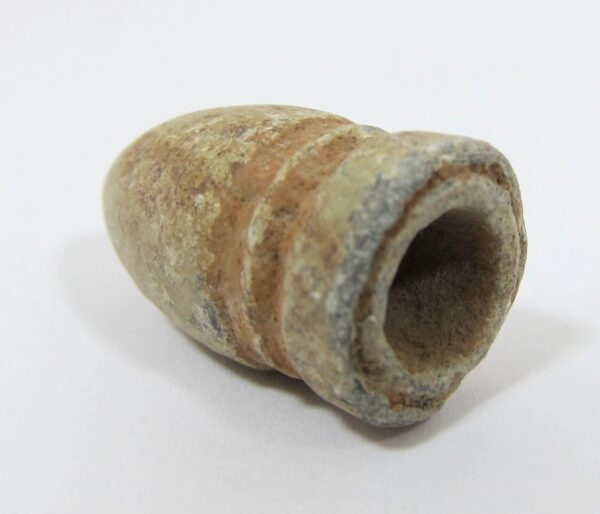
A Confederate Gardner bullet
Jonathan Noyales: Yeah, that’s a great point. And, certainly, that’s not the case at all. So when you think about what Confederate soldiers traditionally are shooting, they’re shooting a more traditional-style minie bullet. There was actually a fellow from New Bern, North Carolina, who had patented the Gardner, so not to be confused with the Gardiner, which is an “i” vs. and “e.” And there are accounts of Confederate soldiers supposedly using captured explosive shells. There’s an account from the Battle of Cool Spring, July 18, 1864, where Union soldiers like Corporal John Lynch of the 18th Connecticut, he swore up and down that when they were retreating across the Shenandoah River, Confederates were shooting explosive bullets at them. And John, as you know, the university, we own part of the Cool Spring battlefield. I spent a lot of my life researching and writing about that battle, and there’s no evidence of explosive bullets being used out there at all.
But what this actually reveals is a major design flaw in the traditional type of musket ammunition that Confederate soldiers were being issued. The Gardner bullet, it’s a conical shaped bullet, has a hollow cavity, but in the manufacturing process, oftentimes they would get air pockets in the lead. And so if you have air pockets in a lead bullet, it has the effect of an explosive bullet. And so that bullet shoots out, air pockets weak, it blasts apart and kind of gives it effect. And we actually have over the years uncovered a number of those at the property. But yeah, I mean, you’re right. It’s not like everybody’s shooting the same type of bullet, Union and Confederate armies. It’s all different. There’s all kinds of innovation. And that’s what war does, right? I think war encourages innovation. What are more effective ways that we can kill, more effective ways we can neutralize the enemy? And when you think about Civil War technology, I think people, rightfully so, think about all the types of firearms that are developed. Not just the rifle muskets, but also the Henry repeating rifle and Spencer carbine and those types of things. But there’s also a lot of innovation that happens with ammunition that, again, directly impacts the outcome of some engagements.
John Heckman: What, in your opinion, is probably the most significant advancement we see in ammunition at this time? What’s the thing where you’re like, that’s stuck around, or that idea stuck around, and they move forward with it?
Jonathan Noyales: I’d have to come back to the Johnston & Dow. I think the idea of this cartridge that is self-contained, I mean, the Civil War is going to produce, certainly, metallic cartridges for like the Spencer and those types of things. But I think for me, that biggest innovation, and if you look really deeply at reports of generals and brigade, division commanders and corps commanders, to me the Johnston & Dow, that combustible cartridge, is a game changer. It is astonishing that it’s not used as much as it could have been based on the amounts that they had in stock. We’re talking millions of rounds. But, again, the reality is the government’s like, well, we’ve got to use what we have first before we go to this. But I think that idea of just taking out loading steps, thinking about the pressures and the anxieties under which soldiers operate in combat and making them think less. I think that’s really, really critical.
There are various accounts during the war where you have dismounted cavalry transformed into infantry. So, another Cool Spring example, there was a thousand troops in the force that fought at Cool Spring that came from 27 different cavalry regiments. And they were transitioned just weeks before that battle to fight as infantry until they could get their mounts. There are numerous accounts of soldiers from that unit who are using muskets at Cool Spring and forgetting the loading process. And so, guys are just forgetting to ram it down, or they’re like, oh, did I load it? Do I need to put another one down there? And so I think anything the government could do, the ordnance department could do to take out loading steps, like the Johnston & Dow, I think that was something that is a significant innovation, right? The less the soldier has to think, the better.
John Heckman: If someone wanted to learn more about Civil War ammunition, what would you tell them? Is there a book that you would tell them about? Is there a presentation in an area at a battlefield you would tell them about? What would you say to them?
Jonathan Noyales: Yeah, so if you’re looking for a book, or a series of books, Dean Thomas, a number of decades ago, wrote what I would regard as the definitive series on Civil War ammunition. It’s called Round Ball to Rimfire. It’s out of print, but you can readily find copies on eBay and those types of places. It really is a great series of books—it’s a multi-volume set—that discusses the evolution of ammunition, the innovations, even going back to all the stuff about the Burton improvements on the minie ball and those types of things. But then offering a lot of really great primary sources from guys who are either testing these things out, using them in combat, generals who are like, this is where we need to go. That to me is the be-all, end-all in terms of print source.
In terms of other places that you can go to learn about ammunition, I’d encourage people to come visit the N-SSA, to see a live match and to really see what can be done. I know that there have been times in recent years where the N-SSA has hosted historians on non-event weekends to let them have an opportunity to shoot all this wide array of firearms that were used during the Civil War. Again, to gain that sense of, all right, you can read the account, but actually seeing what the destructive force of those projectiles can do, I think it gives you a greater appreciation as a historian. It’s like writing about a battle, right? I don’t think you should write about a battle if you haven’t visited that battle site. You can’t write about the destructive force of firearms and ammunition without having a little bit of practical experience with it.
About the Guest
 Jonathan Noyalas is a professor of history and director of the McCormick Civil War Institute at Shenandoah University.
Additional Resources
- The Medical and Surgical History of the Civil War
- North-South Skirmish Association
- Dean Thomas, Round Ball to Rimfire
Sponsored By