 Zethyn McKinley
This portion of the Bethel Cemetery in Sanger, California, includes the grave of former Confederate general Tyree H. Bell.
As I began dreaming up this new blog series, I started to open my eyes to the history around me. I recall being on a tour years ago, and the guide pointing out something about iron fence posts we passed that I otherwise would not have noticed—and that countless people who walk by every day were likely oblivious to as well. This fleeting moment sparked my interest with history that hides in plain sight and is rarely recognized. In this “Unhidden History” series, I want to shed light on such hidden stories—whether overlooked in well-known places or tucked away from the mainstream. For this first installment, I started close to home, discovering just how far the Civil War’s reach extended, even to me in California.
Tyree H. Bell’s Unexpected Californian Resting Place
My search began just a half-hour from my home, in Bethel Cemetery in Sanger, California. There, under golden grass and flanked by orchards, rests Tyree Harris Bell, who served as a Confederate brigadier general during the war. Living so close to this unexpected grave and associated monument, I couldn’t help but wonder: How did a Confederate general from Tennessee end up buried in California’s Central Valley?
Tyree Harris Bell (1815–1902) might not be as universally recognized as some of his more famous contemporaries, but his service in the Confederate army, particularly under the command of the formidable Nathan Bedford Forrest, marked him as a dedicated and effective officer, one Forrest thought of as gallant, courageous, and able.
Born on September 28, 1815, in Covington, Tennessee, Bell hailed from a farming background. Prior to the war, he became a planter, engaged in local affairs, and established himself within his community.
Confederate Service: A Commander Under Forrest
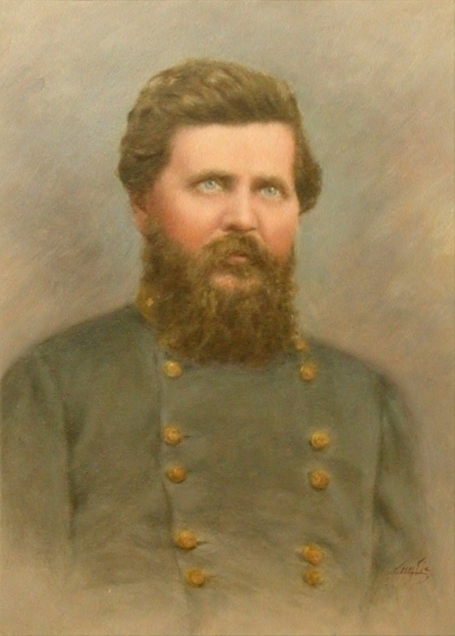 Wikimedia Commons
Tyree H. Bell
The Civil War broke out when Bell was in his mid-forties, and he initially entered Confederate service as a captain in the 12th Tennessee Infantry. His early war experience included campaigns in Kentucky and the struggle for Fort Donelson in February 1862, where he was captured. Following his exchange, Bell rejoined the Confederate forces, and his military career began to accelerate.
Bell’s true strength as a cavalry commander became apparent when he was assigned to Nathan Bedford Forrest’s command. Forrest, known for his aggressive tactics and keen understanding of mounted warfare, quickly recognized Bell’s capabilities. Bell proved himself a fearless and competent leader in numerous engagements, consistently rising through the ranks. He commanded a brigade of Forrest’s cavalry, participating in many of the western theater’s key operations, including the Battle of Shiloh, the Corinth Campaign, and many of Forrest’s raids. Bell’s promotion to brigadier general came on February 28, 1865, just months before the war’s end—a testament to his consistent performance and the respect he garnered from his superiors. He continued to serve with Forrest until their final surrender at Gainesville, Alabama, in May 1865.
Bell’s Post-War Journey West
After the war, like countless other southerners, Bell faced the immense challenges of a society in upheaval during Reconstruction. Seeking new opportunities and a fresh start, he eventually made the significant move westward to California in October 1875. He settled in the rich agricultural lands of the Central Valley, specifically Fresno County, and became a farmer. This region of Central California, which today produces a quarter of the nation’s food according to the USDA, has long been the site of a new start for many families. It’s a connection I feel personally, as my grandmother arrived here with her family from Georgia and Oklahoma during the Dust Bowl of the 1930s, bringing with her our own Confederate roots.
In addition to acquiring and working land, Bell became involved in local politics in the Fresno area, took on leadership roles in veterans organizations, and even held government appointments in nearby Visalia, California. His postwar life reflects a common narrative of former Confederates adapting to peace, building new lives, and integrating into their communities, even in distant territories.
A Tragic End in New Orleans and a Monument in California
Bell’s final months included a series of reunions, including one in Dallas in April 1902 where he led surviving members of Forrest’s cavalry corps through a parade. Afterward, Bell traveled to Tennessee to his nephew’s home and met with former staff members to discuss the history of Forrest’s corps. By July, Bell’s health was deteriorating, and in August, he suffered a stroke. He announced he would return home to California by rail via New Orleans. On August 21, he was found weak and confused at that city’s train station and was aided by ambulance to the New Orleans Sanitarium on Carondelet Street. He died there nine days later. Former Confederate comrades prepared his body for return to California, even dressing him in a new gray uniform for his final journey.
Newspaper accounts, including in the Commercial Appeal, Daily Picayune, and New York Sun, reported Bell’s unconscious collapse and that he died from suffering a blow to his head. On September 5, 1902, The Hickman Courier reported Bell had been “slugged and robbed,” though a police investigation concluded there were no indications of violence. This narrative discrepancy adds another layer to Bell’s story—a dramatic and somewhat mysterious end far from his adopted home.
 Zethyn McKinley
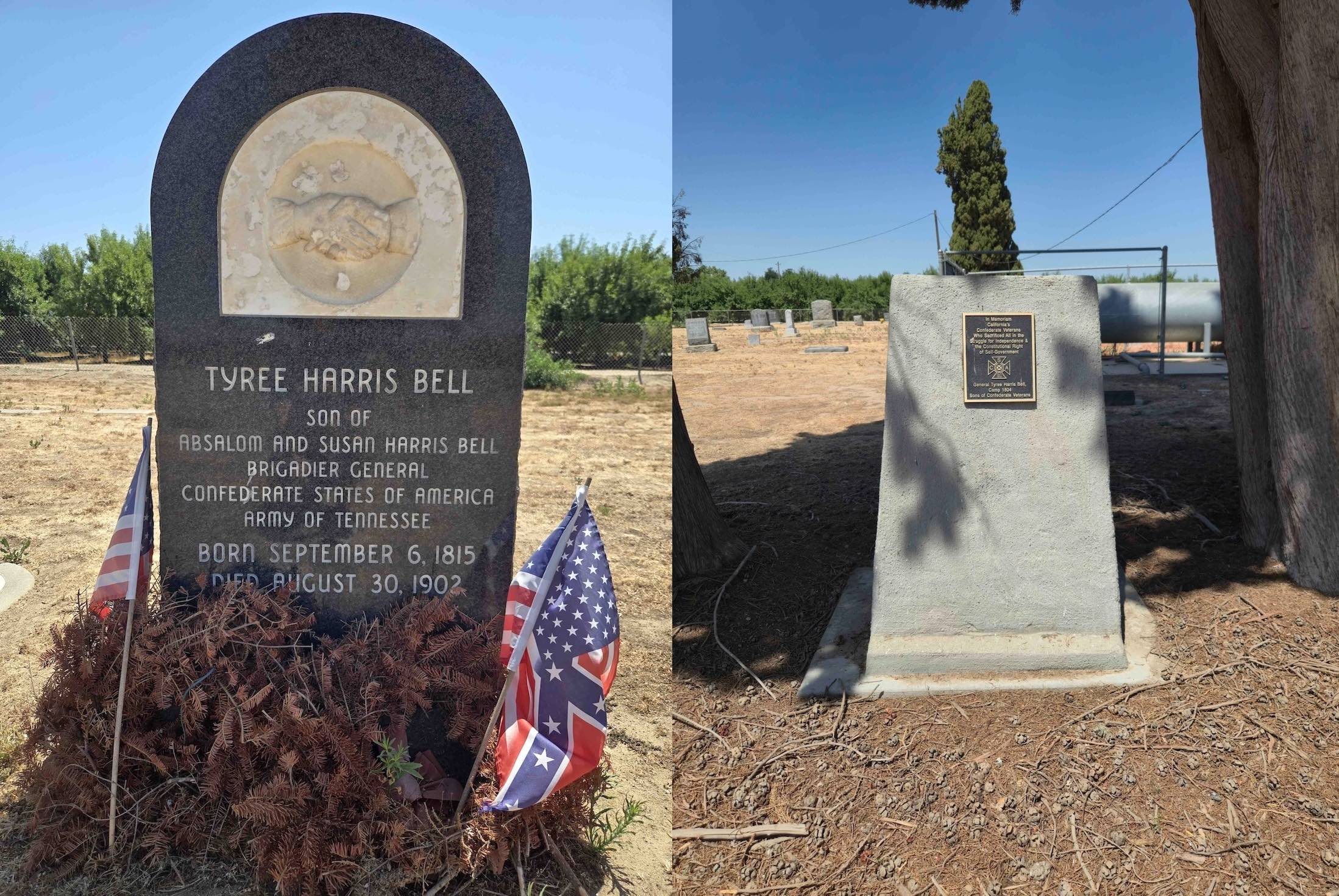
Tyree Bell’s gravestone at Bethel Cemetery (left) and the Sons of Confederate Veterans cement marker to Bell that replaced the marble one defaced during the Confederate monument debates in 2020.
Bell’s small monument in Central California is unexpected, but it marks the final resting place of a man who played a significant role not only in growing crops but also in cultivating the Civil War veteran community in an area thousands of miles from where they once lived and fought. He provided camaraderie and connection for those still grappling with the pain of war.
During the monument debates in 2020, the memorial to Bell erected by the Sons of Confederate Veterans was smashed to pieces and defaced with graffiti reading “God bless Black & Indian [illegible]”—in effect depicting Bell as a symbol of white supremacy. (The vandalized granite memorial has been replaced by a cement one marked with a plaque honoring the “struggle for independence & the constitutional right of self-government” independence and self-government.) His relationship with Nathan Bedford Forrest, a former slaver trader and the first grand wizard of the Ku Klux Klan, is one that will inevitably spark racial discussions. At the same time, Bell’s postwar advocacy for his fellow veterans and his commitment to community building in California are aspects that might also deserve consideration when reflecting on his life.
The Reach of History
In my mind, Bell’s story hints at the profound challenge of rebuilding a life following the devastations of war. His grave is located on the eastern side of the cemetery but his stone faces west. Though likely a coincidence, I like to think its orientation could convey Bell’s eastern roots and his westward journey for his life’s postwar chapter. It also reveals the broad reach of the conflict, both geographically and in the long-lasting roots these veterans laid down in their adopted communities—the effects of which are still observable, sometimes where you least expect to find them. Like in an unassuming graveyard in Central California (which, to my surprise, holds another Confederate cavalry officer, Lieutenant Thomas Conner from Missouri).
In unraveling Bell’s journey, I’ve discovered even more people and places with little-known hints to their Civil War stories hidden in plain view. They will be the topics in the “Unhidden History” series to come.
Zethyn McKinley is a freelance writer and editor with an interest in history, technology, and politics. Beyond her research and writing, she is a certified yoga teacher and blogger at 360 Yoga, where she shares insights on finding physical and mental balance. She resides in California’s Central Valley.
Source
Nathaniel Cheairs Hughes Jr., Brigadier General Tyree H. Bell, C.S.A.: Forrest’s Fighting Lieutenant (The University of Tennessee Press, 2004).

Awesome! Thanks to Ms. McKinley and all those that will stand up, write, and help we descendants and all others to remember our past.